Have you ever heard of the «Biennale du Patrimoine Horloger»?
I guessed so.
But well, imho, you should have.
Every two years (at least that’s the plan, hence the name), numerous watch companies and institutions (45 this time in 2026!) in Le Locle, La Chaux-de-Fonds and Saint-Imier their doors to offer a sneak peek.
There is an overwhelming choice, and the biggest problem is choosing where to go.
We decided to visit a few of the ‘big’ ones on the one hand, and some smaller, lesser-known suppliers on the other.
This article will not give a complete overview of the ‘Biennale’, we rather report, what we’ve experienced.
This article has less pictures as usual – the reason being, that in most locations it was not allowed to take pictures or at least it was very restricted. At Cartier, they slapped a little sticker onto our mobile phone lenses; at Patek, we had to leave our mobiles in the cloakroom altogether.
That, however, was a relatively minor challenge; what proved far more demanding was the fact that all the guided tours were conducted in French. It was, however, always possible to ask questions in english; generally the friendliness of basically everyone was really heartwarming.
Cartier
We started with Cartier. We had the option of choosing between the modern factory building (which houses the CNC machines etc.) and the old farm building, which is home to the ‘Maison des Métiers d’Art’; we opted for the latter.
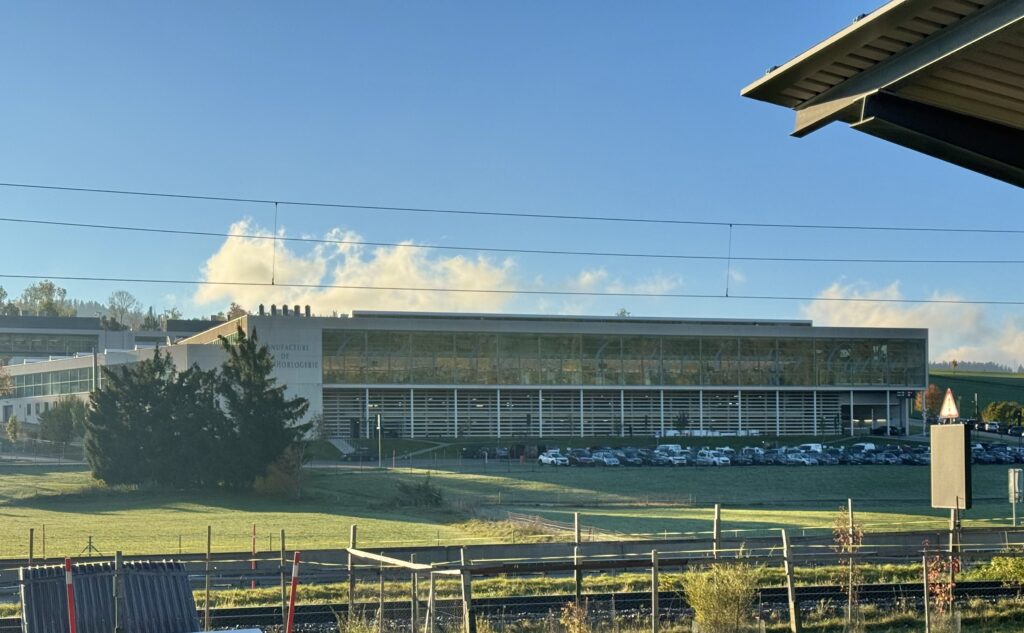
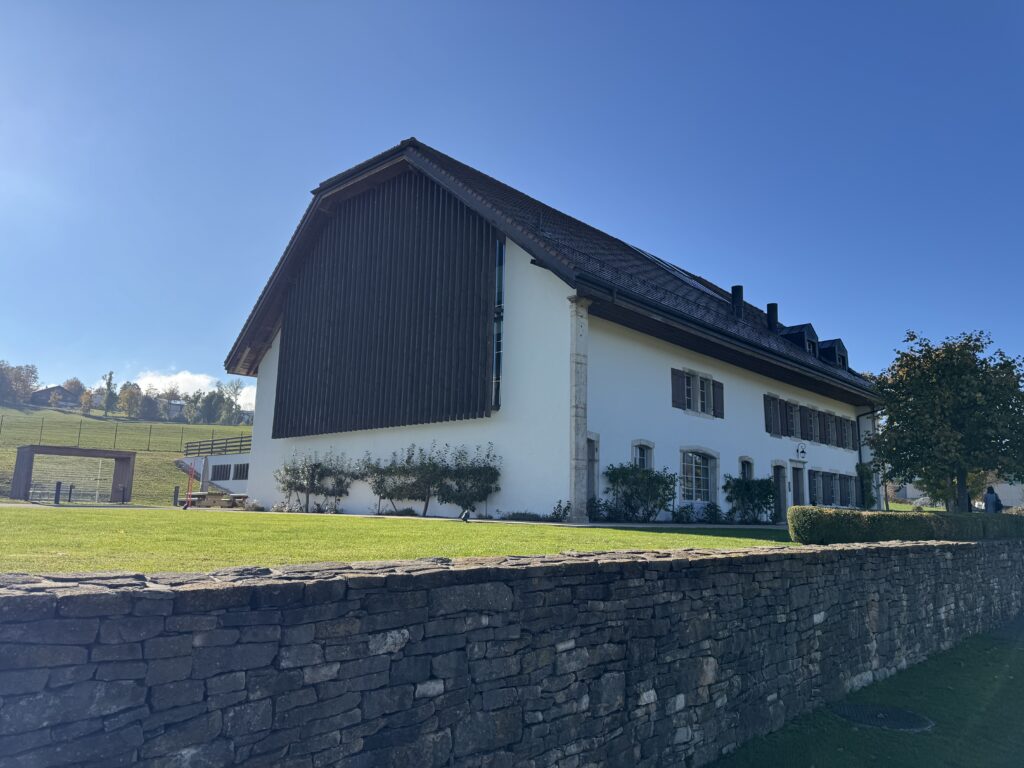
Behind the wooden shades in picture 2 there is a massive window facing north-east – as usual in ancient and modern watchmaking buildings.
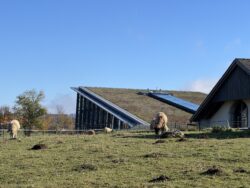
The spectacular Greubel Forsey building, located in the immediate vicinity, is oriented in exactly the same way geographically.
More pictures of the Maison des Métiers d’Art’– including from inside – can be found here.
After a warm welcome with (very welcomed at 8:30h) coffee and pastries (and the application of the a. m. sticker) we started the tour.
First some very nice and old meeting and presentation rooms and then we entered the main production area where we did see some 50 workstations, each of the them quite similar, although the work done differs from desk to desk sometimes quite dramatically. Nearly each desk is equipped with a microscope and a workplace lighting – and a small screen showing the work schedule for each employee.
Looking „over the shoulder“ of the artisans is absolutely fascinating. Sculpting and engraving golden “panthers“, straw marquetry, stone setting, enamelling … even marquetry with heat treated coloured steel … every conceivable form of craftsmanship can be experienced here side by side.
The variety is just as overwhelming as the artistry. But innovation and development are also taking place here.
NB: the «Révélation d’une Panthère» can be used to explain the difference between innovation and development:
the „temporary visible“ panther is an innovation using gold balls rolling over an engraved dial to temporarily revealing the animals head. This is achieved by placing the balls in a liquid with the same refractive index as the sapphire glass.
Then a customer wanted this – many of the products which leave this building are very limited editions or unique pieces – made with platinum balls. Which requires the development of a different liquid and a matching crystal!
To me one of the coolest pieces we were shown was the cushion case watch, which looks like an „ordinary“ cushion case with diamonds – but the stones are actually set into a sensational metal structure, which allows the cushion to be actually soft and can be pressed into!
Finally we went into the room where the complications are assembled. In comparison to what we have seen before quite … ordinary …
The 90 minutes were packed with so much information – but let’s go on to Patek Philippe.
Patek Philippe
The manufacturer from Geneva has a site in La Chaux-de-Fonds, too, in which daughter companies produce escapements, cases and perform stone setting.
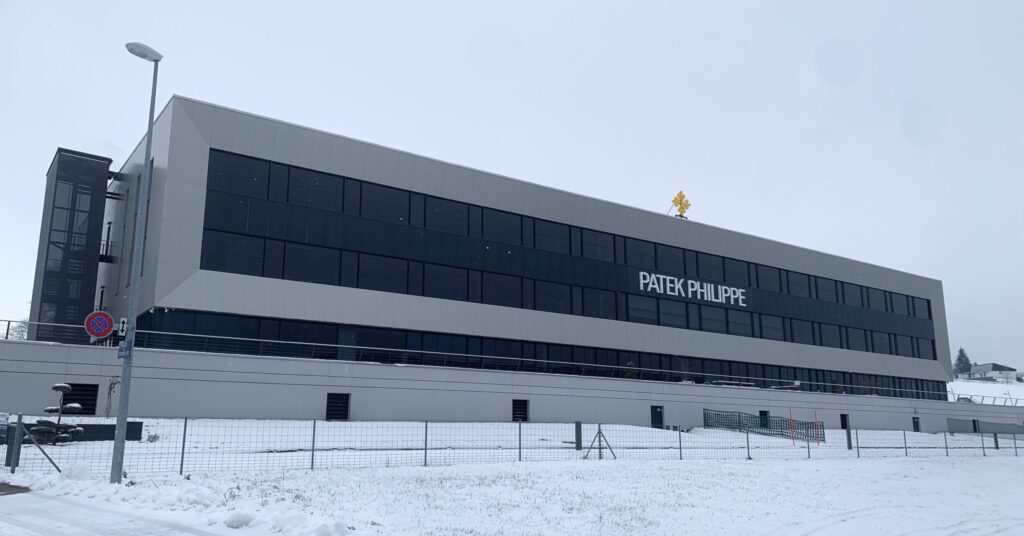
Note that above picture is obviously not taken during this visit, as photographs were strictly forbidden, even outside!
Inside the contrast to Cartier could not be bigger. While everything was of course neat and clean, it was, especially compared to what we’ve seen an hour ago, very plain and understated, very „industrial”.
After a detailed explanation about stone setting we came to the the room with the smell of drilling oil. High end CNC-machines next to cardboard routing cards, modern laser and measurement equipment next to manual polishing. You can’t imagine how meticulously the manual polishing of bezels (fixed in a kind of play dough) is performed. There are around 20 workbenches lined up side by side, where skilled workers carry out all the chamfering, grinding and satin-finishing work.
We could also have a glimpse on new polishing robots, one of them has just been “trained” by a human.
Currently – so we have been told – this is only for the basic work before the bezel is handed over to the humans … but who knows what the future holds.
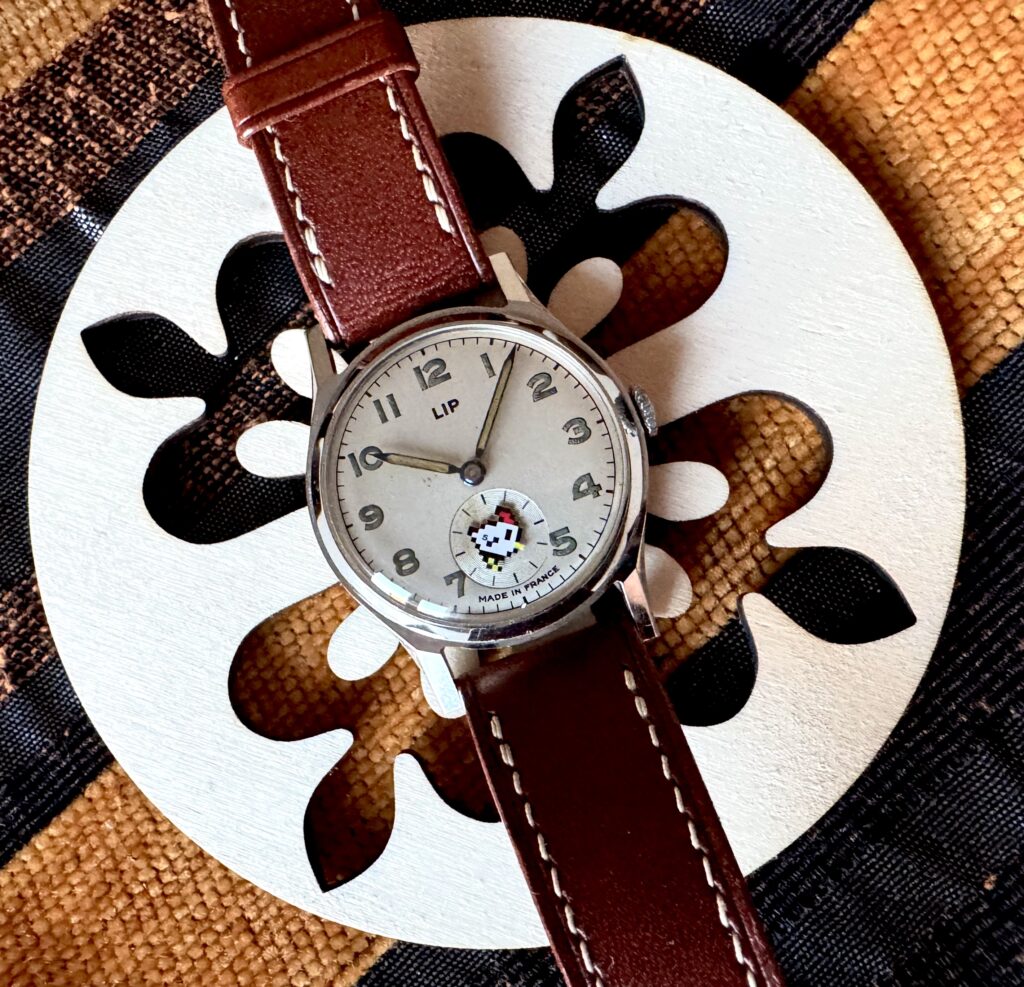
Corum
The next stop was very different again:
Corum does not appear the have any production in their building (the movements of the new integrated sports watch are custom-made by Concepto), but it was quite impressive anyway.
While Cartier was «art» and Patek «factory», Corum oozed «style».
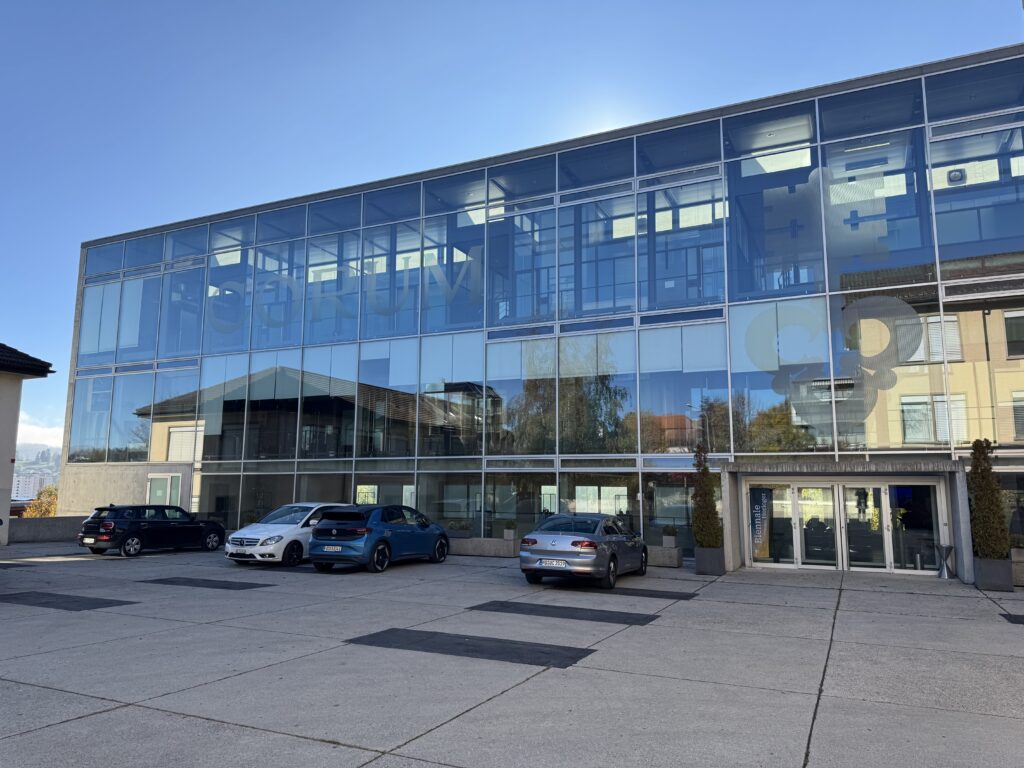
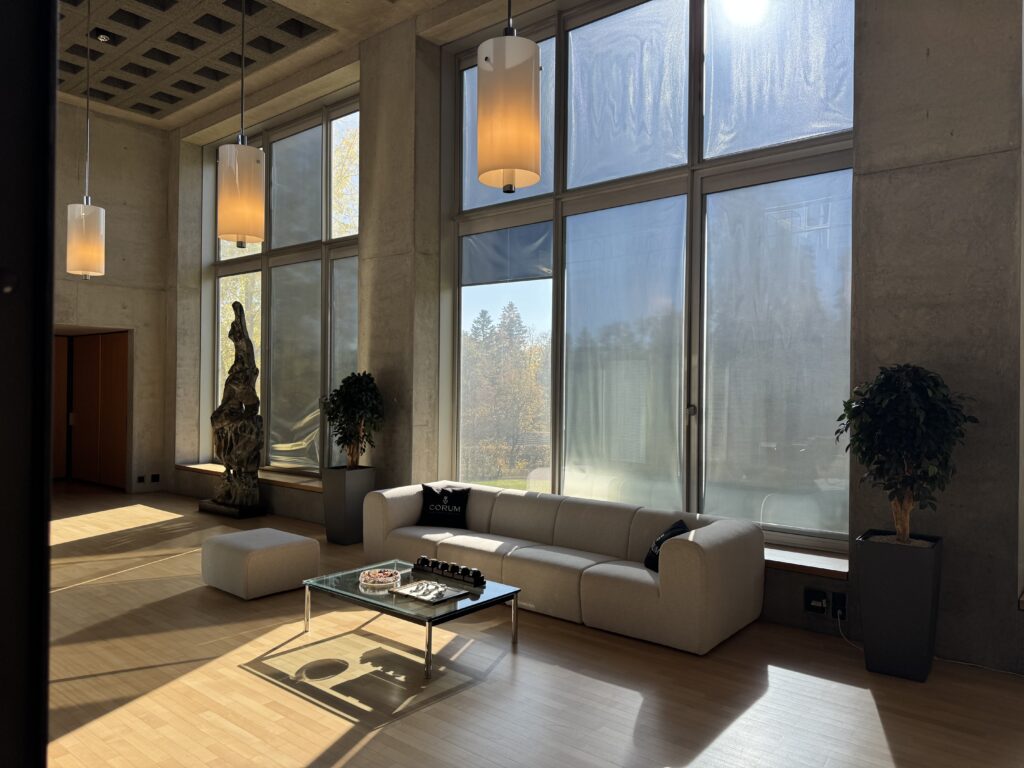
The tour at Corum began with a look back at the company’s rich history (did you know that Corum was the first company to use meteorites and peacock feathers for watch dials back in the 1980s?) and was followed by an overview of the current product range.
ochs und junior
Last stop on the first day was (some of you know) my favourite brand ochs und junior.
Vaguely similar to what I have said about Corum, you don’t see CNC-machines or anything like that in the villa in which the brand is located.
That said, the two brands could not be more different.
ochs und junior is specialised on calendar and astronomical complications which are realised by very simple, not complicated, constructions conceived by mastermind Dr. Ludwig Oechslin.
While all parts are manufactured by small, specialised partners in the area (movements by ETA, Sellita and Ulysse Nardin) all watches are assembled in the villa. Our focus, however, have been the new products.
Even the new colour ways are something completely different from those of other brands, the bright colours of the prototypes you see below are PVD coated dials by the local partner „Positive Coating“.
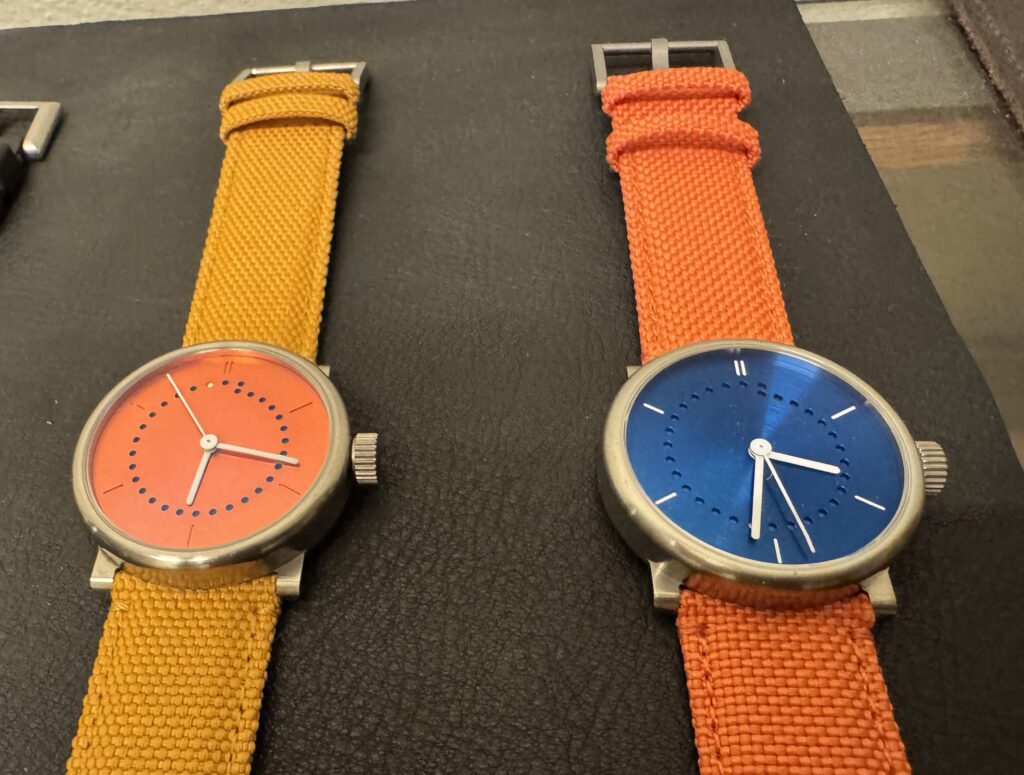
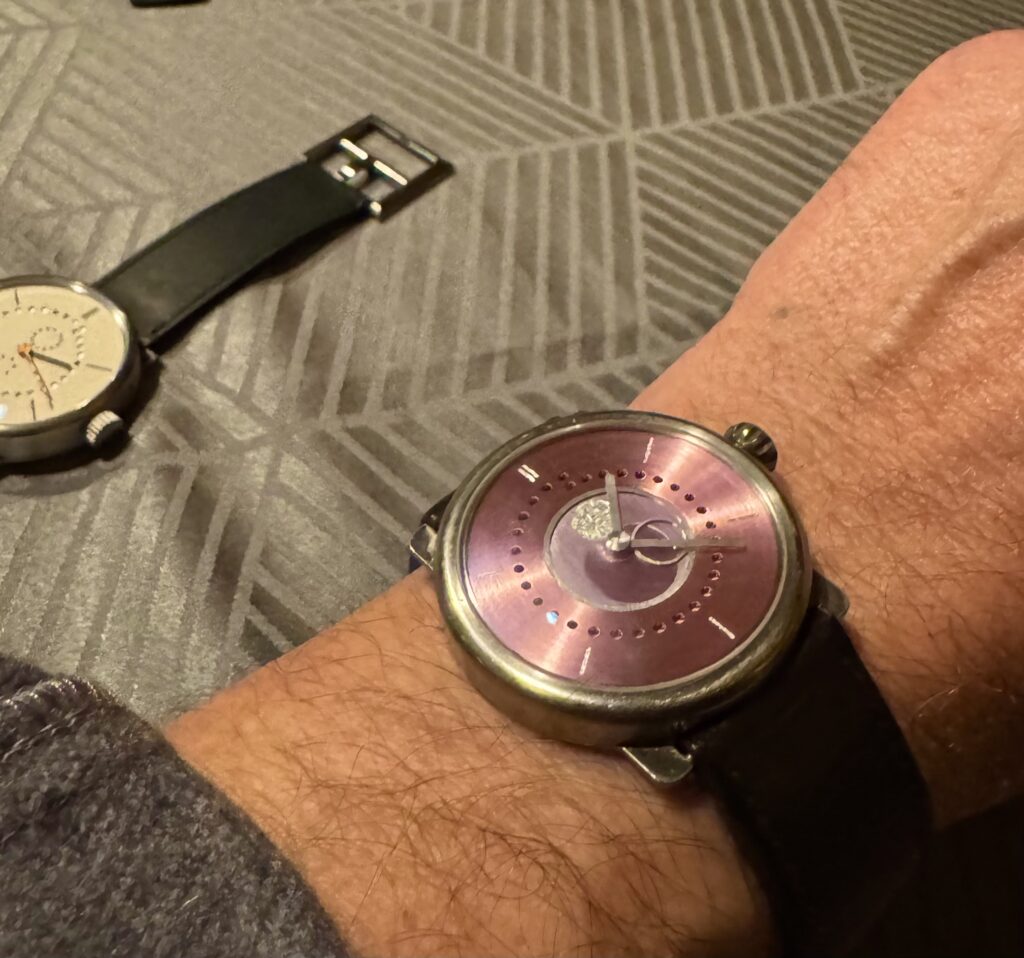
But ochs und junior would not be ochs und junior, if there would not be more:
we had a look at he new mind-blowing astronomic desk clock (prototype) and the as practical as clearly designed four year calendar.
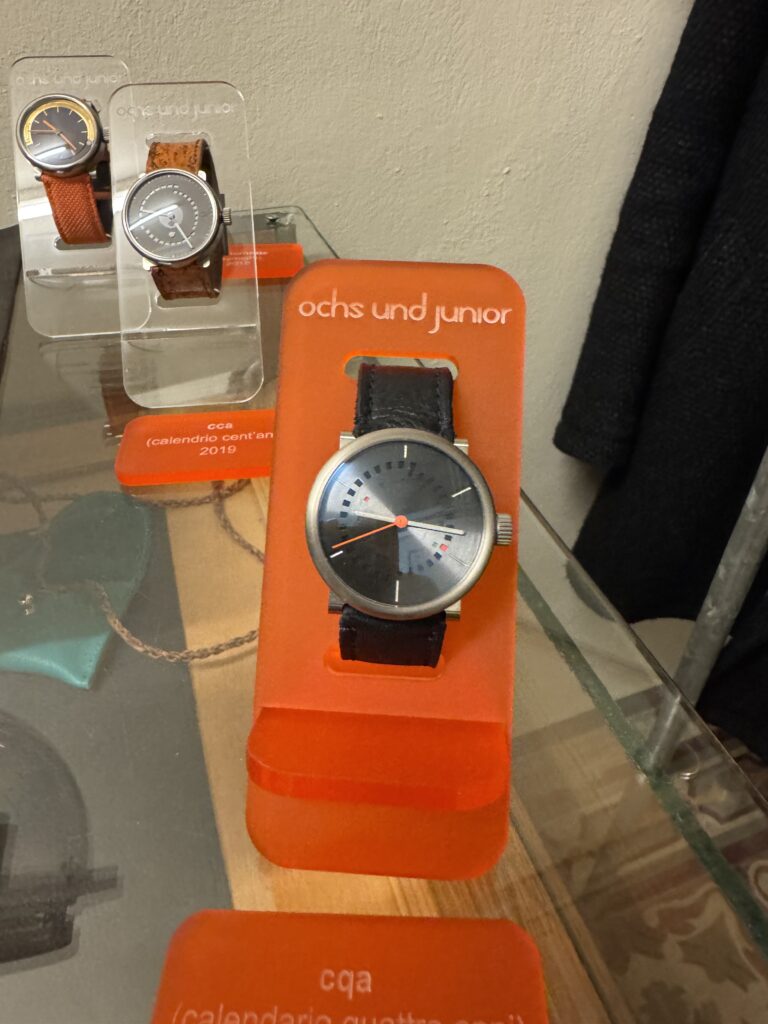
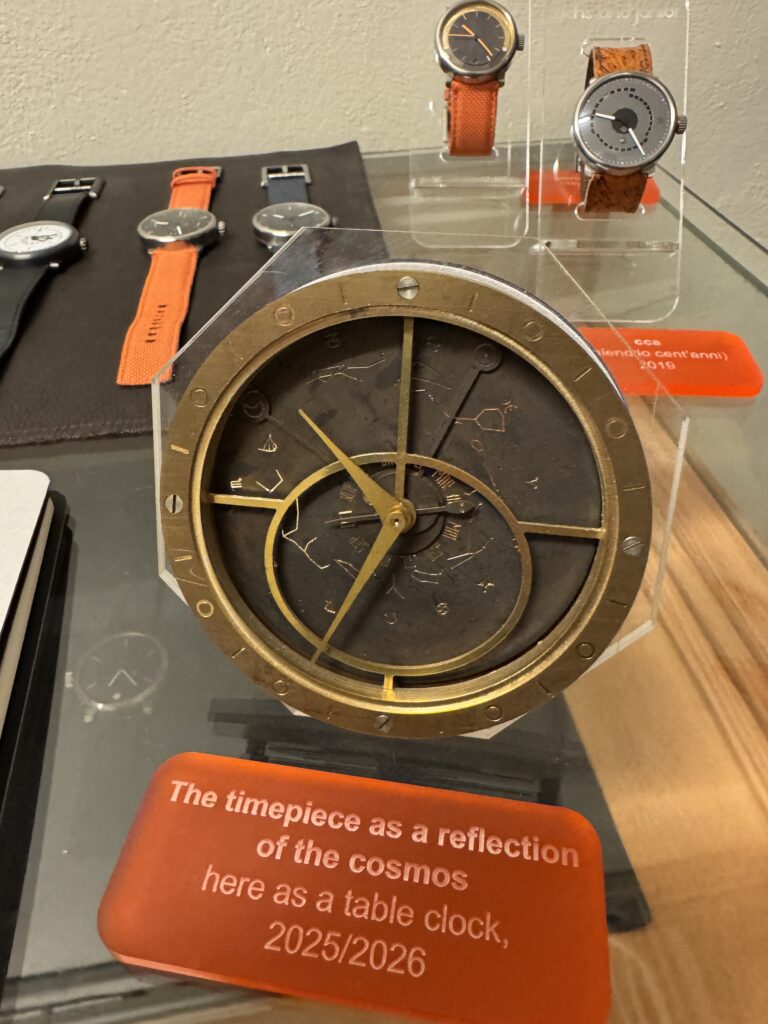
On the second day we concentrated on an aspect, which I find increasingly interesting: the suppliers and partners.
Alatron/Neprowatch
Alatron is something in between a brand and a supplier/partner. While they actually did not take part in the Biennale, they opened their doors for us anyway.
You may have never heard of Alatron, but you certainly have seen their products many times …
When we arrived on our hotel the night before, we saw the ubiquitous wall clocks in the lobby.
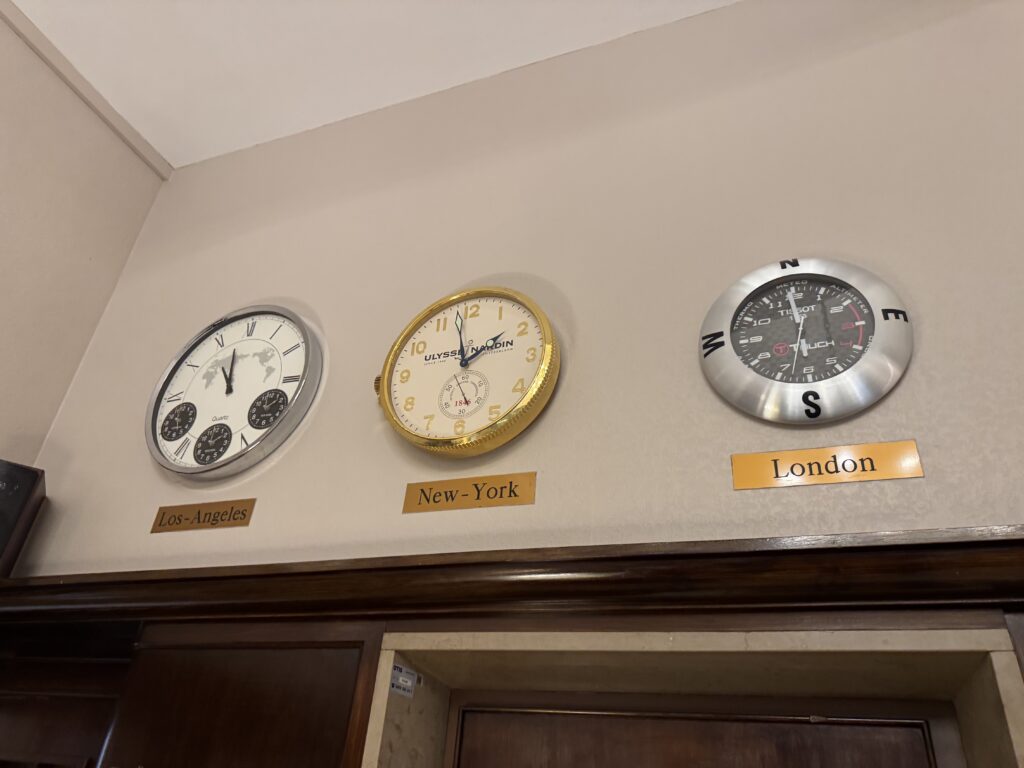
These wall clocks we all see and admire at out local AD, in good restaurants and hotels (where only our good parenting prevents us from grabbing the Leatherman to unscrew them from the wall …).
Alatron ist the company making all of those. The photo below was taken in their office; they also took me into a sort of showroom (where I was once again asked not to take any photos), where a wide variety of wall and table clocks from just about every brand imaginable illustrated Alatron’s broad customer base.
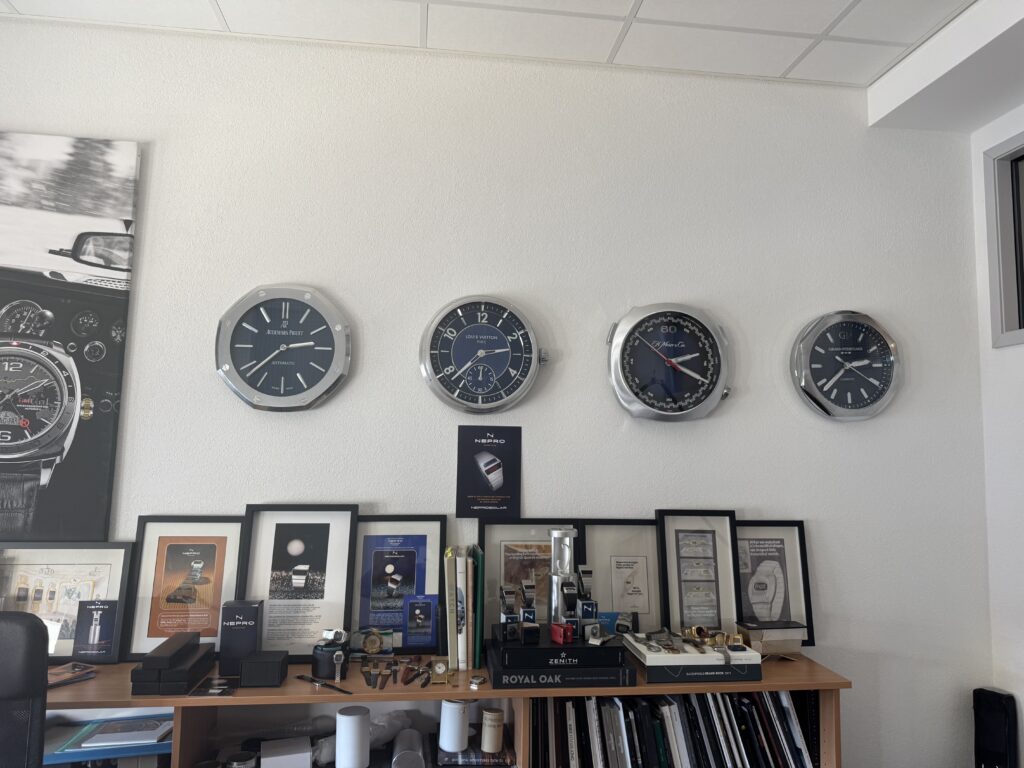
But this was actually not the reason for us to visit them.
A while ago they found in an old cardboard box a watch, which the father of the founder of Alatron, Dr. Paolo Spadini, developed in the 1970s. Extremely advanced for its time it featured not only an LED display, but also a solar panel to supply the energy. While the idea and the design was groundbreaking, the available technology was not advanced enough for a sustainable product. Well today this is different and the son, Daniele Spadini, decided some 50 years later to bringe the „Neprowatch“ to life.
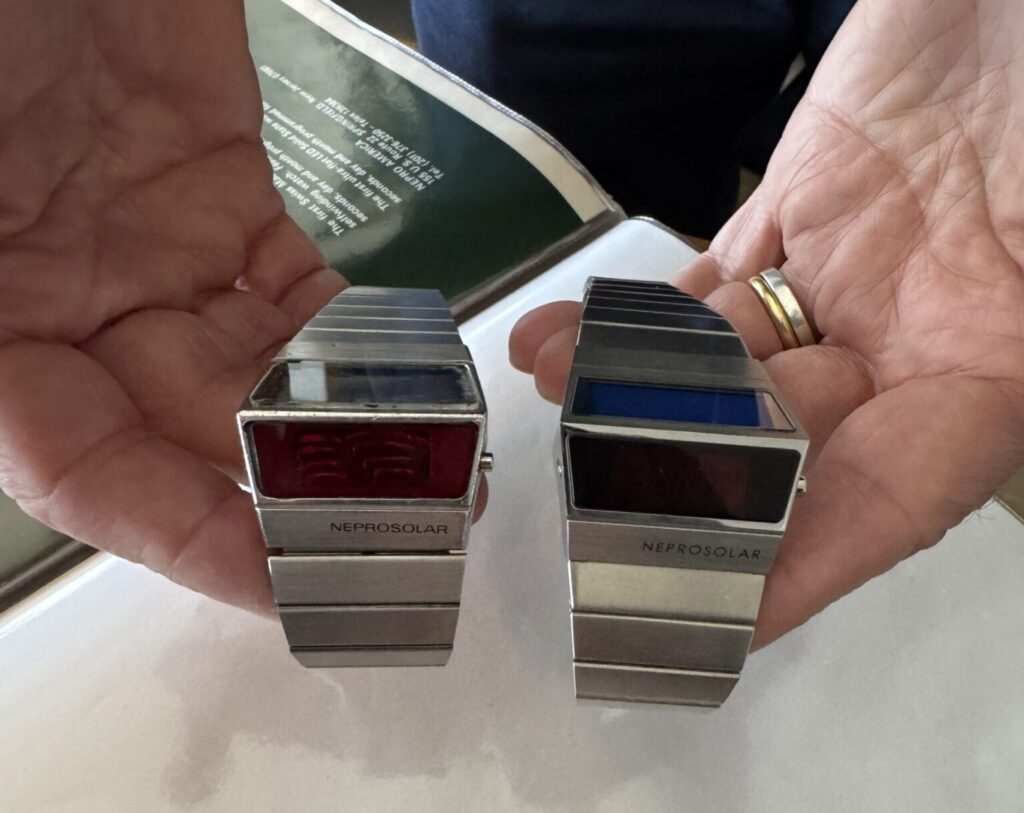
Did I like the watch in the metal?
Well it was my latest NWA …
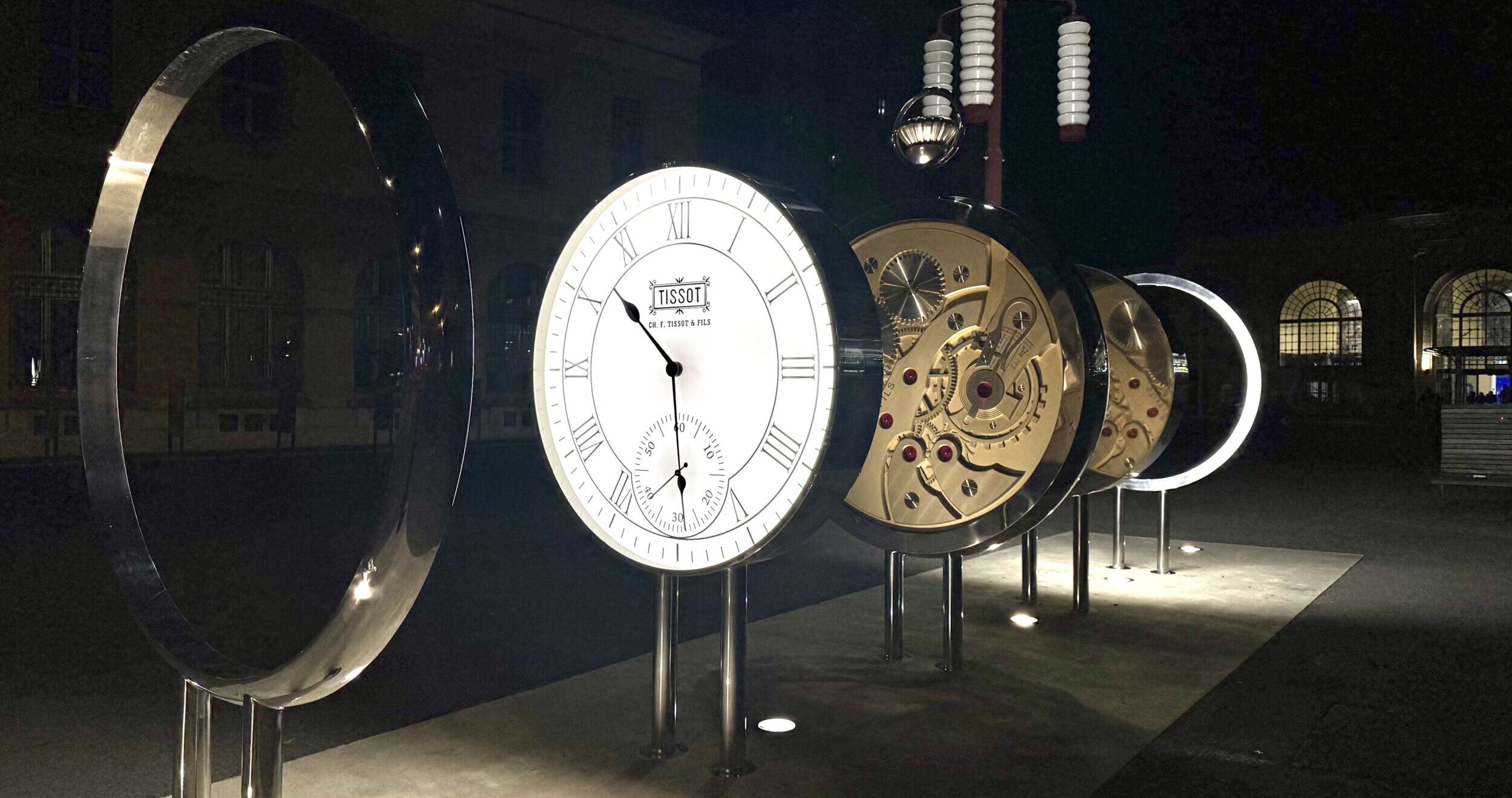
PS: look at the ‘cover photo’ for this article; this huge ‘deconstructed watch‘ adorns the station forecourt of La Chaux-de-Fonds … and was made by Alatron, too …
Horlyne
Horlyne is one of the typical hidden champions. They work for many big brands, and yet ‘nobody’ has ever heard of them.
During our visit, we saw a dial and a bridge being worked on that looked suspiciously like those from Richard Mille and Girard-Perregaux, respectively; also our friend @watchesandwords has commissioned three dials there, so they work for a very broad range of customers.
While Horlyne offers a broad range of services, we were given a detailed tour of three of them: stone setting (again;-)), anlage/polishing and guillochage.
The guilloche room is full of ancient (as old as 1906!) machines offering all sorts of different techniques.
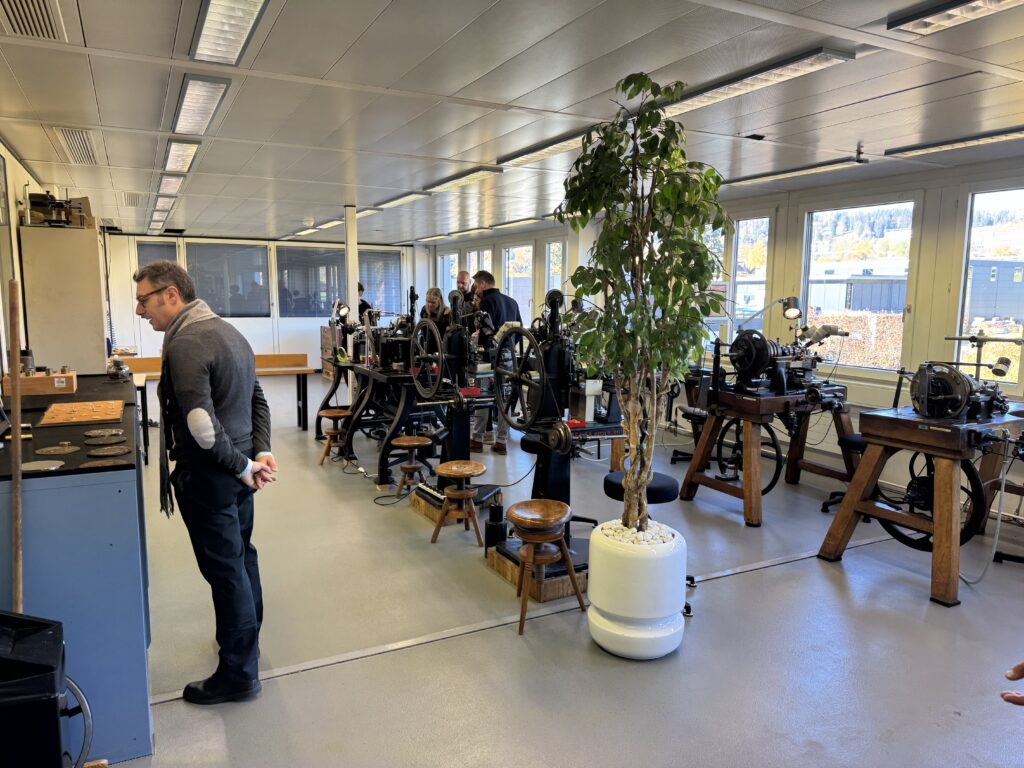
We got demonstrations on vertical (fixed dial, moving graver) and rotary guilloche (rotating dial, moving graver) and – quite impressive – a “pantograph” version:
A pattern-disk (in the past made of Bakelite, these days 3D-printed) serves as a template and is traced by a metal stylus, whose movements are transmitted to the engraving tools. This made it possible, even over a hundred years ago, to transfer virtually any pattern onto the dial.
The look of these guilloche dials is just amazing, even without further work such as enamelling.
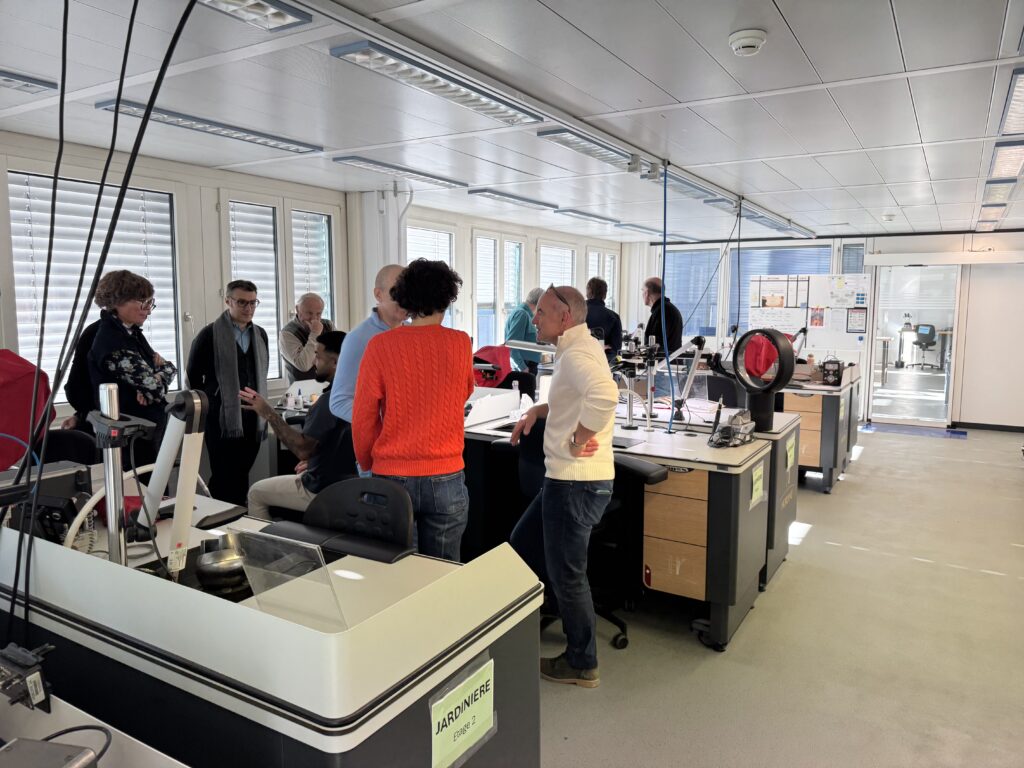
Polishing on the other hand (sic!) requires a completely different set of qualifications and tools. Not the hard graver, pieces of special wood are used to even out hard metal surfaces.
He spends about three hours working on a part the size of a GP bridge. Usually after one (sometimes more, if he feels “in the flow”) hour he needs a break. Easy to relate to, if you remember, that the whole work takes place looking though a microscope.
Metallo Tests
Talking about microscopes … well at Metallo Tests they probably say „That’s not a microscope … That’s a microscope“ when they show their «Field-Emission Scanning Electron Microscope» with a resolution down to single-digit nanometers (a human hair is some 70.000 nm thick) which is used to track down potential problems for watch manufacturers amongst others. You can even look back in time with it and detect the origin of the metal, i. e. if gold was recycled.
Next to high-tech like this and gas chromatographs they also have self-developed and -manufactured machines for testing everything you can think of on the world of watches, jewellery, packaging and more.
From the more obvious tests for Vickers hardness to sweat resistance (with different standard (artificial) sweat qualities for different ethnic groups!), everything you can think of is tested for reliability and safety.
Bracelets are twisted 1.000s of times to check dependability, leather bands are shredded and tested for unwanted chemicals and rubber straps are subjected to artificial ageing by UV radiation. Cases are subjected to shocks and chemicals, bezels are turned for hours on end and pushers are pushed …
It’s hard to imagine just how much effort must have gone into the ‘minor details’ during the development phase.
Conclusion
A friend (@nautec07) asked „What do you see differently now compared to before this experience?“.
Well, roughly speaking, I already had a rough idea of how things are done in the workshops and that the watchmaking industry is as secretive as it is based on the division of labour.
But to „look and feel“ it on site makes all the difference!
Wolfgang (@w_a_t_c_h_s_t_y_l_e), in turn, asked „Will you visit the next Biennale in two years time?
Absolutely! To me this was actually more valuable than Watches and Wonders or Geneva Watch Days.
Because you don’t ‘only’ see watches, you get to experience things, you can’t experience somewhere else!
The only thing I did miss a bit was more networking with fellow enthusiasts (it did happen, but not to the extent you see in Geneva).
So we suggested to the organisers (who were as helpful as they were friendly, thank you!) that they offer English-language tours next time – an idea they were happy to take on board!
We look forward to seeing you in 2028!
(You can buy us a beer if there are English-language tours on the schedule that time😁)

Leave a Reply
You must be logged in to post a comment.